Buyer Guides · · 6 min read
VO2 Max Testing as a Revenue Line: Equipment, Protocols and Pricing
Updated August 12, 2026 · by the WellnessEquip Indonesia supply desk
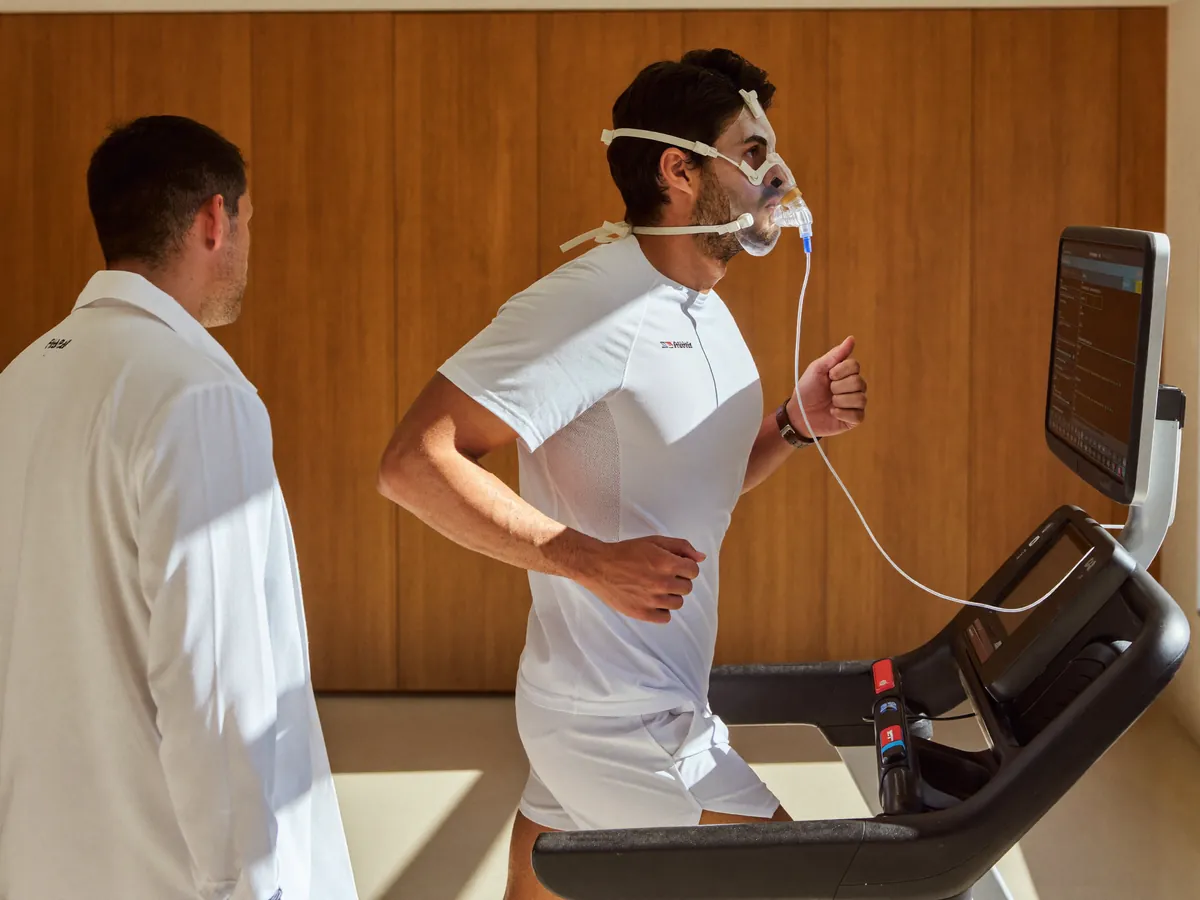
Three years ago, when our supply desk quoted a metabolic analyzer, we had to explain what VO2 max was. In 2026 the calls run the other way: coaches in Canggu, longevity clinics in Ubud and executive gyms in Jakarta SCBD tell us their clients are asking for the test by name. The trigger was the longevity movement — a widely cited Cleveland Clinic cohort of over 120,000 patients published in JAMA Network Open found cardiorespiratory fitness to be one of the strongest single predictors of all-cause mortality researchers have measured, with no upper limit to the benefit. When a biomarker predicts lifespan that strongly and can be improved with training, people will pay to know their number. This guide covers the physiology, the protocols, the three analyzers we actually install, and the service pricing that makes VO2 max one of the fastest-payback offerings in wellness.
What the test actually measures
VO2 max is the maximum rate at which the body can transport and use oxygen, expressed in millilitres per kilogram of body weight per minute. During a test, the client breathes through a mask while a breath-by-breath analyzer measures ventilation together with the oxygen and carbon dioxide fractions of expired air. From those signals the software computes oxygen uptake (VO2), carbon dioxide production (VCO2) and the respiratory exchange ratio (RER) in real time as workload climbs.
A proper maximal protocol is a graded ramp to volitional exhaustion: on a cycle ergometer the resistance rises 15–30 watts per minute; on a treadmill, speed and incline step up every one to three minutes. A well-run ramp lasts eight to twelve minutes after warm-up. You accept the result as a true maximum when the classic criteria line up — a plateau in VO2 despite rising workload, an RER at or above 1.10, and heart rate near the age-predicted ceiling. Along the way the software identifies the two ventilatory thresholds, VT1 and VT2, which is where the commercial magic lives: those thresholds convert directly into personalised five-zone training prescriptions, and the training plan is what clients renew month after month.
Safety first — and it is manageable
Maximal testing is demanding, so screening is not optional. Every client completes a PAR-Q+ questionnaire; anyone flagging cardiovascular symptoms, medications or relevant history gets referred for physician clearance before a maximal test — or you run a submaximal protocol that stops at 85 percent of predicted heart rate and extrapolates. Staff should hold a current first-aid certificate, and the testing room needs air conditioning: in Bali humidity, an un-cooled ramp test ends early for thermal reasons rather than cardiovascular ones, which wrecks data quality. Test early in the day, hydrate clients, and log conditions.
The equipment we install, compared
| System | What it is | Test types | Price (USD / IDR) | Best fit |
|---|---|---|---|---|
| PNOE VO2 max analyzer | Portable breath-by-breath analyzer with cloud reporting | VO2 max, ventilatory thresholds, active metabolic rate, RMR | ~$24,000 / ≈IDR 385 juta | Coaches, PT studios, gyms, retreats — the portable route in |
| KORR CardioCoach | Fixed-station metabolic system built for fitness facilities | VO2 max, submax protocols, RMR options | ~$15,000 / ≈IDR 240 juta | Gyms adding a permanent testing lane with simple workflows |
| COSMED Q-NRG metabolic cart | Clinical metabolic monitor focused on resting energy expenditure (canopy and mask modes) | Gold-standard RMR for medical weight-loss and nutrition programs | ~$60,000 / ≈IDR 960 juta | Medical clinics pairing resting metabolism with exercise testing |
The ~ figures are indicative landed estimates — the final price is confirmed by a supply manager and moves with the exchange rate, the freight method and the delivery route.
Two notes on that table. First, the Q-NRG is deliberately positioned differently: it is the resting-metabolism instrument — dilution-canopy REE measurement is the clinical standard for weight-loss medicine — while PNOE and CardioCoach carry the exercise side. Ambitious clinics buy one of each and own the full metabolic story. Second, budget for the ergometer: a quality treadmill or cycle ergometer adds IDR 80–250 juta unless your gym floor already has one that ramps precisely.
What to charge — Indonesian market rates
Across our client base, a full VO2 max test with a zone report retails at IDR 1.5–2.5 juta ($90–150) in Bali and Jakarta premium facilities, IDR 1–1.5 juta in second cities like Bandung and Yogyakarta. RMR tests sell for IDR 800,000–1.5 juta. The winning menu structure is a bundle: test + printed zone card + an eight-week programmed block + a re-test, packaged at IDR 4–6 juta. The re-test is the genius part — improvement is nearly guaranteed for untrained clients, and a measurably rising VO2 max is the most powerful retention hook we have seen in any category. Pair the report with muscle-mass data from an InBody 970 body composition analyzer and every test becomes a two-metric progress story.
Payback math on the entry route: a PNOE at ≈IDR 385 juta landed needs roughly 160–250 paid tests to break even. A studio in Sanur running just four tests a week clears that inside twelve to fifteen months — before counting the programming revenue the thresholds unlock. The CardioCoach at gym volumes typically pays back in nine to twelve months; the Q-NRG earns its keep inside medical weight-loss packages, which we mapped in our metabolic testing for weight-loss programs guide.
Talk to a supply manager on WhatsApp — we will send current landed pricing, a room checklist and sample client reports from each analyzer.
Which setup to choose if…
- You are an independent coach or boutique PT studio in Canggu: start with the PNOE. It is portable enough for on-site corporate days, the cloud reports look premium, and the capital risk is the lowest among portable breath-by-breath systems.
- You run a full-service gym adding an assessment lane: the KORR CardioCoach gives you a fixed, idiot-proofed station any certified trainer can operate after a half-day of training.
- You are a medical or weight-loss clinic in Jakarta: lead with the COSMED Q-NRG for clinical REE, add PNOE for exercise capacity, and fold both into screening packages alongside cardiovascular diagnostics from our metabolic testing catalog.
- You run a retreat or wellness resort in Ubud or Uluwatu: PNOE plus a cycle ergometer travels between properties; sell arrival/departure testing inside multi-day programs — the model behind the medical fitness trend we profiled.
Who actually books the test
Three audiences fill the calendar in Indonesia. Longevity clients — typically 35 to 60, expat-heavy in Bali, fluent in the podcast literature — book maximal tests and want the mortality-curve conversation. Endurance athletes — the triathlon and cycling communities around Sanur, Uluwatu and Jakarta — buy threshold data, re-test quarterly and are the most loyal cohort we see. And corporate groups book screening days where a submaximal protocol plus an RMR reading gives every employee a metabolic report without maximal-effort risk. Market each segment differently: longevity clients respond to biological-age framing, athletes to race-pace numbers, HR departments to aggregate reporting. One analyzer serves all three — the menu copy does the segmentation work.
Operational checklist before launch
- Room: 3 × 4 m minimum, air-conditioned to 20–22 °C, power for the ergometer and analyzer, a fan, and floor space for post-test recovery.
- Consumables and hygiene: masks, mouthpieces, filters and turbine sanitisation between clients — budget IDR 30,000–60,000 per test and build it into pricing.
- Calibration: follow the manufacturer schedule for flow and gas calibration; we train your staff on it at installation and include calibration checks in service visits.
- People: one certified trainer or exercise physiologist per shift; the analyzer software handles interpretation, but a human explains zones and sells the program.
- Compliance: units ship from our Denpasar and Jakarta warehouses with import and AKL paperwork handled; priority delivery across Bali via our Canggu service area, door-to-door nationwide including Batam and Medan.
VO2 max testing hits a rare sweet spot: science your clients already believe in, hardware from IDR 80 juta, per-test pricing north of a million rupiah, and a built-in re-test loop that compounds retention. If you want the number for your own business — capacity, pricing, payback for your city — message our team on WhatsApp and we will build the model with you, then back it with equipment, training and support. For the recovery side of the same coin, see our HRV monitoring guide.
The WellnessEquip Indonesia supply desk sources, imports and installs wellness equipment across Indonesia. Questions about your project? Message a supply manager on WhatsApp — honest answers, no hard sell.
— FAQ
Frequently asked questions
How long does a VO2 max test take?
The maximal ramp itself lasts eight to twelve minutes, but book 45–60 minutes per client: screening, mask fitting and calibration, warm-up, the ramp to exhaustion, cool-down and a results walkthrough. Realistic throughput is one client per hour per station.
How much can I charge for VO2 max testing in Indonesia?
Premium facilities in Bali and Jakarta retail the test at IDR 1.5–2.5 juta ($90–150) including a training-zone report; second cities support IDR 1–1.5 juta. Bundles with an eight-week program and a re-test at IDR 4–6 juta convert best and drive retention.
Is VO2 max testing safe for untrained clients?
With screening, yes. Every client completes a PAR-Q+ questionnaire; flagged cases are referred for physician clearance or tested with a submaximal protocol that stops at 85 percent of predicted heart rate. Staff hold first-aid certification and the room stays air-conditioned — heat is the main practical risk in tropical Indonesia.
What equipment do I need to start a VO2 max testing service?
A breath-by-breath analyzer (PNOE around $24,000 or KORR CardioCoach around $15,000), a treadmill or cycle ergometer with precise ramping, masks and hygiene consumables, and an air-conditioned 3 × 4 m room. Medical weight-loss clinics add a COSMED Q-NRG for resting metabolic rate.
— Keep reading
Related guides
Business · 6 min read
Metabolic Testing: The Missing Engine in Your Weight-Loss Program
Programs that measure RMR keep clients two to three times longer than programs that guess. Real equipment prices, 12-week program design and the ROI math for adding metabolic testing to weight-loss services in Indonesia.
Buyer Guides · 6 min read
HRV Monitoring for Clinics and Gyms: What to Measure, What to Buy
Your clients already track HRV on wearables — clinics need to offer something better. The metrics that matter (RMSSD, SDNN), the professional devices we install, and four business models that turn autonomic data into revenue.
Trends · 6 min read
The Medical Fitness Trend: Turning Gyms Into Health Providers
Gyms are adding clinical-grade testing and clinics are adding supervised training — and both are buying the same equipment. What medical fitness means, why Indonesia is ready, the service stack with real IDR pricing, and a 90-day rollout plan.