Business · · 6 min read
The Wellness Retreat Business Model, Rebuilt for Indonesia in 2026
Updated August 12, 2026 · by the WellnessEquip Indonesia supply desk
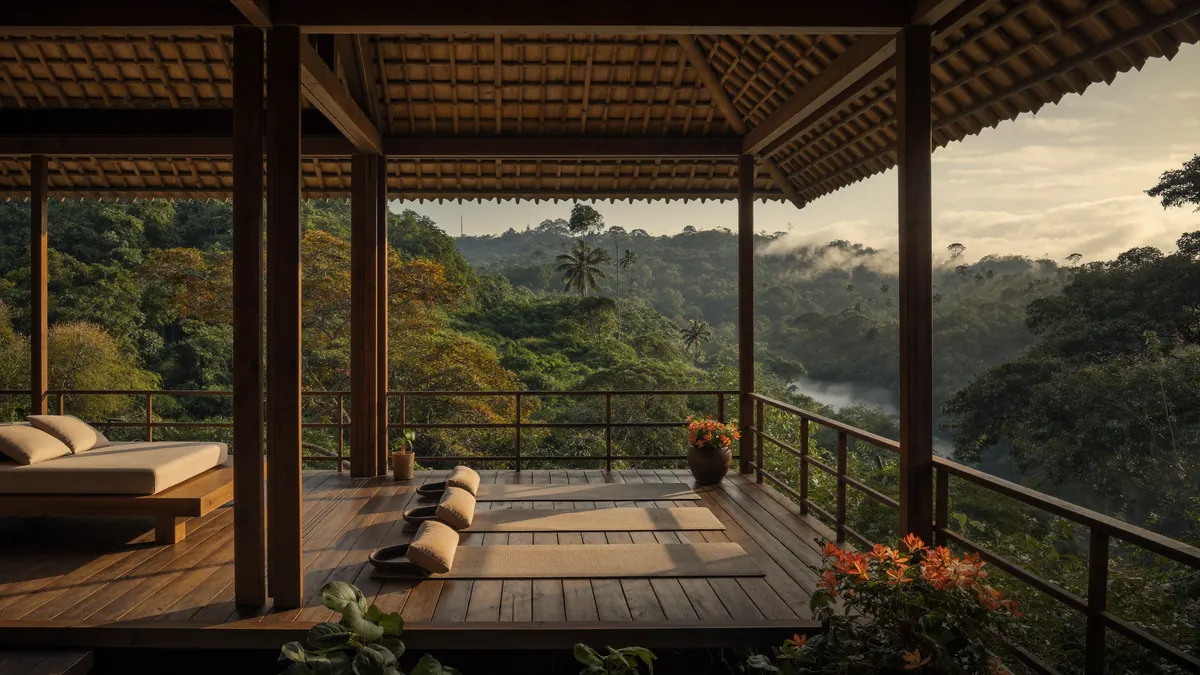
We have delivered equipment to retreat properties from the Ubud jungle ridge to a beachfront build in Lombok, and we have also watched two beautifully designed retreats quietly close within eighteen months. The difference between the ones that compound and the ones that fold is rarely the yoga shala or the architecture — it is whether the founder treated the retreat as a business model with a program margin engine, or as a lifestyle purchase with guest rooms attached. This article lays out the wellness retreat business model as we see it from the supply side: where the revenue actually comes from, what a 12-villa property earns, and why measurement equipment has become the highest-leverage investment on the whole site.
The market is real — and it pays differently
The Global Wellness Institute puts wellness tourism above $830 billion globally and growing in double digits — faster than tourism overall — with Asia-Pacific the fastest-expanding region. The number that matters for a retreat founder, though, is spend-per-guest: GWI's data consistently shows wellness travelers spending well over baseline tourists, and structured retreat guests are the extreme case — they buy a program, not a room, and they book five to seven nights instead of Bali's two-to-three-night average. We unpacked the island-level demand data in our wellness tourism Bali market report; the supply-side conclusion is that generic villa stock is oversupplied while credible program-led retreats still sell out their calendars months ahead.
Revenue anatomy: where retreat money actually comes from
| Revenue stream | Share of revenue | Typical gross margin |
|---|---|---|
| Accommodation (packaged) | 45–55% | 60–70% |
| Programs: coaching, classes, assessments, treatments | 25–35% | 70–80% |
| F&B (included + à la carte) | 12–18% | 55–65% |
| Retail, transfers, other | 5–10% | 40–60% |
The structural insight: programs carry the best margins and near-zero marginal cost once staffed, yet most founders spend 95% of capex on buildings that earn the worst margin line. Shifting even 10 points of revenue from rooms to programs transforms property-level EBITDA — retreats we supply that run program-heavy models report 22–30% EBITDA against the 12–18% typical of rooms-led boutique properties.
Unit economics: a 12-villa retreat in Ubud
A composite model built from properties we have equipped around Ubud, at stabilized year-two trading:
| Line | Assumption | Annual |
|---|---|---|
| Accommodation revenue | 12 villas × 65% occupancy × $310 packaged ADR | $882,000 |
| Program revenue | arrival/departure assessments, courses, 1:1 sessions | $405,000 |
| F&B and retail | $205,000 | |
| Total revenue | $1,492,000 | |
| Operating costs | staff 28–34 FTE, F&B cost, utilities, marketing, maintenance | −$1,090,000 |
| EBITDA | ≈27% | $402,000 |
Two honesty notes. First, year one rarely looks like this: ramp, agency commissions and pre-opening payroll usually hold first-year EBITDA under 15%. Second, occupancy is program-driven — retreats with published, dated programs (a “Metabolic Reset Week” starting the first Sunday of each month) fill shoulder seasons that undated “stay anytime” retreats never fill.
Why measurement is the retreat differentiator
Every retreat promises transformation; almost none can prove it. That is the gap equipment closes, and it changes four numbers at once. Price: an assessment-bookended program justifies $200–400 more per stay than an identical unmeasured one. Conversion: “you will see your biological age change” outsells adjectives on every landing page test our clients have run. Rebooking: guests who leave with a departure re-test and a six-month follow-up target rebook at 40%+ versus the 18% we see at comparable unmeasured properties — and the re-test books the return visit before departure, exactly the mechanic we described for hotels in how wellness equipment increases hotel revenue. Referrals: a before-and-after report is the single most shared artifact a retreat produces.
Equipment stacks by retreat type
| Retreat type | Core stack | Budget |
|---|---|---|
| Yoga / detox / mindfulness | Body composition (ACCUNIQ), blood pressure, AGE Reader mu biological age scanner, HRV wearables | $75,000–85,000 (Rp 1.2–1.35 miliar) |
| Fitness / performance | InBody 970, PNOE VO2 and metabolic testing, Styku 3D scanner, recovery corner | $160,000–180,000 |
| Medical longevity retreat | Adds arterial stiffness, point-of-care blood chemistry, skin imaging, physician suite | $280,000–420,000 |
Stack budgets are indicative landed figures — the final price is confirmed by a supply manager, because it moves with the exchange rate, the freight method and the delivery route. Three devices earn their keep fastest in retreat settings. The AGE Reader mu biological age scanner (~$45,000) delivers the emotional headline number in twelve seconds, non-invasively, on arrival day. The PNOE metabolic analyzer (~$24,000) turns breath into a personalized nutrition and training prescription your chef and coaches can actually cook and program against — see the wider options in our metabolic testing category. And the Styku S100 3D body scanner (~$37,500) produces the rotating avatar that becomes the guest's shareable before-and-after. A medical-tier build pulls from the same longevity stack we specified in our guide to opening a longevity clinic in Bali — and at that tier, clinic licensing rules begin to apply, so plan the legal side with it.
Talk to a supply manager on WhatsApp — tell us your retreat type and guest count and we will send a costed stack with a program menu it can support.
A five-day program with measurement touchpoints
- Day 1 — Arrival assessment: body composition, biological age, resting metabolism, HRV baseline; results reviewed in a 30-minute consult that personalizes the week.
- Day 2–3 — Program core: movement, nutrition and recovery blocks tuned to the data; wearable HRV tracks how guests adapt.
- Day 4 — Progress check: mid-week body water and recovery review; program adjusted, upsells (massage, contrast therapy, coaching) land naturally here.
- Day 5 — Departure re-test and roadmap: repeat key measurements, hand over the before-and-after report, set a six-month target, and book the return re-test at member pricing before checkout.
Payback math on the diagnostic stack
Take the performance trio at $105,000 installed. A 12-villa retreat turning 20 arriving guests weekly, with 65% taking the $130 assessment bundle (most retreats simply build it into the package price, which is cleaner): 13 guests × $130 × 4.3 weeks ≈ $7,270 monthly, plus mid-week and departure re-tests, private consult upsells and the pricing premium on the package itself — call it $9,000–10,000 monthly gross, roughly $2,500 of operator time and consumables against it. Net $6,500–7,500 a month pays the stack back in 14–16 months, before counting the rebooking uplift that is, long term, the biggest line of all.
Where to build: notes from the ground
Ubud remains the category's spiritual capital with the deepest practitioner labor pool. Canggu and Uluwatu suit performance and surf-adjacent concepts but carry Bali's fastest-rising land costs. Lombok offers beachfront economics Bali lost a decade ago — we shipped a full assessment suite to a Kuta Lombok build last year, door to door from Denpasar in under a week, commissioning included. Yogyakarta is the sleeper: domestic wellness demand plus culture-tourism flows, at land prices that make a 20-villa masterplan feasible. Wherever you build, our Denpasar and Jakarta warehouses deliver AKL-registered equipment nationwide with confirmed delivery timelines across Bali and Java.
Pre-opening equipment checklist
- Order diagnostics 3–4 months before opening — sea freight plus AKL verification is the long pole, and training practitioners on live devices takes two weeks you do not want to spend after guests arrive.
- Wire the assessment room with dedicated 220V circuits and hold air-conditioning under 24°C; analyzer accuracy drifts in tropical heat, and jungle-edge builds in Ubud are the worst offenders.
- Decide package-included versus separately paid assessments before printing the rate card — switching mid-season confuses booking agents and guests alike.
- Build the departure re-test and return-visit booking into your checkout flow from day one; retrofitting the habit into staff later is the hardest change we ever ask for.
- Name one team member as equipment owner for calibration schedules, consumable stock and the WhatsApp line to our engineers.
The bottom line
The wellness retreat business model works in Indonesia when programs — not rooms — carry the margin, and programs sell best when they are measured. Buy the diagnostic stack that matches your concept, publish dated programs, and engineer the re-test rebooking loop from day one. Message our supply desk on WhatsApp and we will turn your concept deck into an equipment budget you can put in front of investors.
The WellnessEquip Indonesia supply desk sources, imports and installs wellness equipment across Indonesia. Questions about your project? Message a supply manager on WhatsApp — honest answers, no hard sell.
— FAQ
Frequently asked questions
How profitable is a wellness retreat business in Indonesia?
Program-led retreats we supply report 22–30% EBITDA at stabilized trading, versus 12–18% for rooms-led boutique properties. A composite 12-villa Ubud model shows roughly $1.49 million revenue and about $400,000 EBITDA in year two, with year one substantially lower during ramp.
What equipment does a wellness retreat need?
A yoga or detox retreat can start with body composition, blood pressure, an AGE Reader mu biological age scanner and HRV wearables for $75,000–85,000. Performance retreats add VO2 and metabolic testing plus a 3D scanner at $160,000–180,000, and medical longevity retreats run $280,000–420,000.
Do assessments really increase retreat rebooking rates?
Yes — properties running arrival and departure testing with a six-month follow-up target see rebooking above 40%, versus around 18% at comparable unmeasured retreats. The mechanic is booking the return re-test before the guest checks out.
Where is the best place to open a wellness retreat in Indonesia?
Ubud has the deepest practitioner pool and brand gravity, Canggu and Uluwatu fit performance concepts at higher land costs, Lombok offers beachfront economics Bali lost a decade ago, and Yogyakarta pairs domestic demand with affordable land. Delivery and commissioning reach all of them from Denpasar and Jakarta.
— Keep reading
Related guides
Trends · 6 min read
Wellness Tourism in Bali: The 2026 Market in Numbers
Six million foreign arrivals, a 40% wellness spending premium and five distinct sub-markets from Ubud to Sanur. A supply-side breakdown of Bali's wellness tourism economy — with the service prices and equipment budgets that make it work.
Business · 6 min read
How Wellness Equipment Increases Hotel Revenue: The Real ROI Math
A correctly sized hotel wellness setup pays back in 6–14 months. We break down equipment tiers, session pricing, ADR uplift and a full worked example for a 60-room Seminyak property.
Business · 6 min read
How to Open a Longevity Clinic in Bali: Licenses, Budget, Equipment
Legal structure, clinic licensing, AKL device registration, three equipment budget tiers and honest payback math — everything we tell founders who want to open a longevity clinic in Bali.