Buyer Guides · · 6 min read
3D Body Scanning for Gyms and Studios: Which Scanner to Buy
Updated August 12, 2026 · by the WellnessEquip Indonesia supply desk
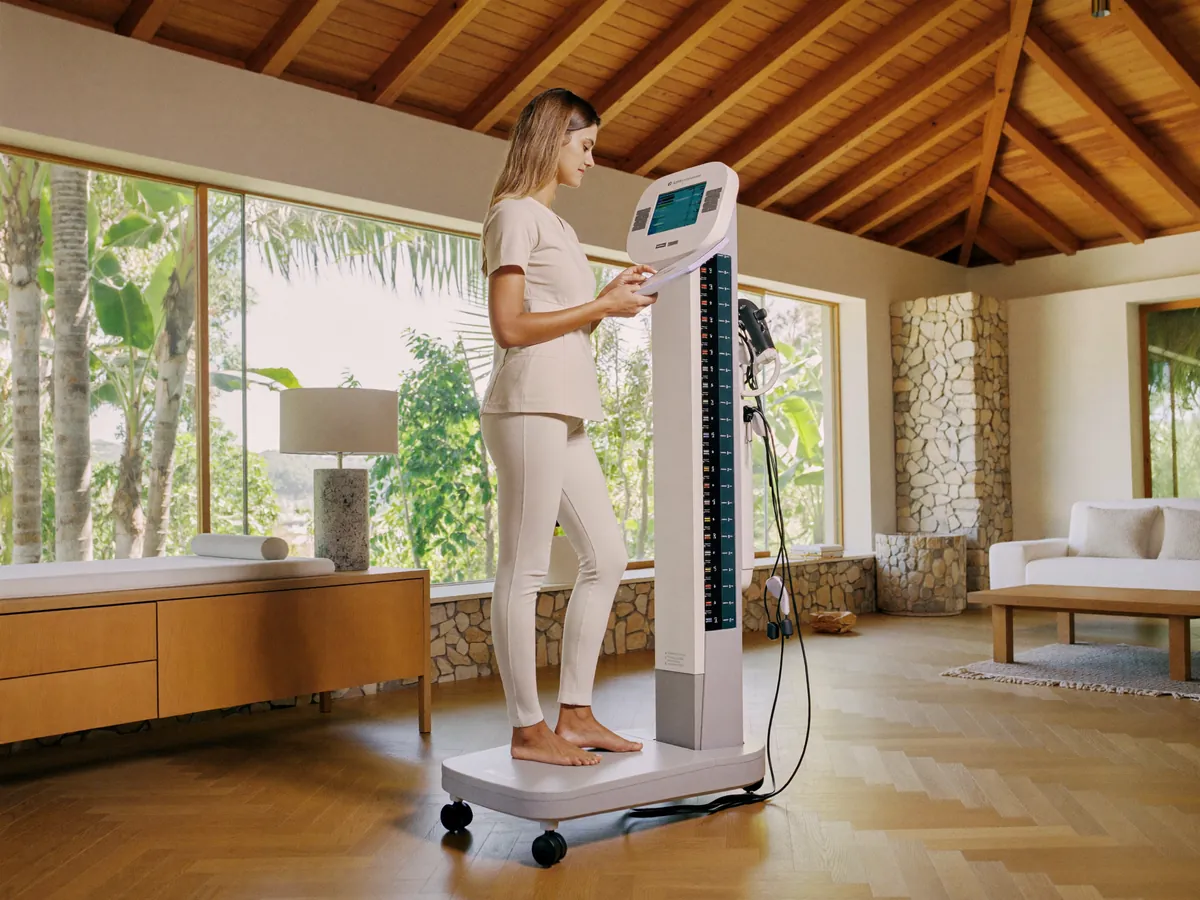
A gym director in Jakarta put the retention problem to our supply desk in one sentence: members do not quit because training stops working — they quit because they stop seeing it work. The scale lies, the mirror is slow, and motivation dies in the gap. That gap is precisely what 3D body scanning closes. Six weeks of training rarely moves the scale much, but it visibly moves waist, hip and thigh circumferences — and a rotating avatar comparison makes the change undeniable. After equipping gyms and studios from Canggu to Surabaya with scanning hardware over the past three years, here is our honest guide to the technology, the four systems we install, and the numbers behind the investment.
How 3D body scanning actually works
Fitness scanners are built around infrared depth sensing. The scanner projects structured infrared light — or times reflected pulses — while the client stands on a slowly rotating turntable or in front of a rotating tower. Over a 35–40 second rotation the sensor captures hundreds of depth frames, each a cloud of distance measurements. Software stitches the frames into a watertight 3D mesh, detects anatomical landmarks, and extracts 400+ measurements automatically: circumferences at waist, hip, chest, limbs; lengths; surface areas; volumes; and posture markers such as shoulder tilt and forward head position.
Two honest technical caveats we always give buyers. First, repeatability beats absolute truth: with a consistent stance protocol, trunk circumferences repeat within a few millimetres scan-to-scan, which is exactly what progress tracking needs — but sloppy positioning, loose clothing or wet hair can swamp real change, so protocol discipline matters. Second, a 3D scanner measures shape, not tissue. Body-fat percentages from scanners are estimated from shape equations, so treat them as trend indicators and pair the scanner with a bioimpedance unit — our body composition analyzer guide covers the pairing — for measured composition alongside measured shape. An InBody 970 plus a 3D scanner is the strongest assessment corner in fitness.
Beyond fitness scanning: posture and movement
Two adjacent technologies belong in this conversation. Rasterstereography — the method inside the Formetric 4D posture analysis system — projects a light grid onto the bare back and reconstructs the spinal line, pelvic position, kyphosis and lordosis angles from the surface geometry, radiation-free. It is the physio-grade instrument for posture programs. Markerless motion capture — the Kinetisense motion capture system — uses depth cameras to track joint centres live, scoring range of motion, squat mechanics and balance without suits or markers. Where a fitness scanner documents what a body is, these document how it holds and moves — and they justify entirely different service menus.
The four systems compared
| System | Technology | Scan time | Output | Price (USD / IDR) | Best fit |
|---|---|---|---|---|---|
| Fit3D ProScanner | Rotating turntable, infrared depth tower | About 40 seconds | 3D avatar, 400+ measurements, posture report, wellness metrics, member web portal | ~$30,000 / ≈IDR 480 juta, plus monthly software | Big-box gyms and chains — kiosk-style self-serve flow |
| Styku S100 3D scanner | Turntable plus infrared depth camera | About 35 seconds | High-resolution avatar, 600+ measurements, body-shape trends, fat estimates | ~$37,500 / ≈IDR 600 juta, plus software | Boutique studios, PT gyms, med-spas — small footprint, polished visuals |
| Formetric 4D | Rasterstereographic light projection | Seconds per capture | Spinal line, pelvic tilt, kyphosis/lordosis angles, 4D motion sequences | ~$105,000 / ≈IDR 1.7 miliar | Physio, chiropractic and medical-fitness clinics |
| Kinetisense | Markerless depth-camera motion capture | Live capture | ROM, functional movement and balance scores, side-by-side session comparisons | ~$15,000 for the licence-and-camera package | Sports performance, rehab, PT assessment lanes |
The ~ figures above are indicative landed estimates: the final price is confirmed by our supply manager for your order, since it moves with the exchange rate, the freight method and the delivery route to your city.
Fit3D vs Styku vs Kinetisense: price, footprint and software
| System | Indicative price | Footprint | Software | Time per client |
|---|---|---|---|---|
| Fit3D ProScanner | ~$30,000 plus monthly software | ~1.2 × 1.2 m rotating platform, standing height; up to 227 kg | Fit3D cloud, API and member app | 40 seconds |
| Styku S100 | ~$37,500 plus software | Turntable plus tower, 1.5 × 1.5 m | Styku cloud suite with EMR export | 35 seconds |
| Kinetisense | ~$15,000 licence and hardware bundle | Fully mobile kit: depth sensor plus a Windows laptop or tablet | Posture, ROM, KAMS functional movement and balance modules | 2–5 minutes |
In short: if members should scan themselves, the Fit3D kiosk flow fits; for polished avatars in a boutique studio, the Styku; if floor space is tight or you assess movement rather than shape, Kinetisense packs into a bag. Every scanner we supply is listed in the 3D body scanner and posture catalog.
Which to choose if…
- You run a large gym or a chain in Jakarta or Surabaya: the Fit3D ProScanner. Members scan themselves in a kiosk flow, results land in their own portal, and staff time per scan approaches zero — the economics chains need.
- You run a boutique studio or PT business in Canggu or Seminyak: the Styku S100. It fits in two square metres, the avatar renders are the best-looking in the category, and the compact footprint leaves room for a BIA unit beside it.
- You are a physio, chiro or medical-fitness clinic in Sanur or Bandung: the Formetric 4D turns posture from an opinion into an angle-by-angle report — and supports the medical-fitness positioning we described in our medical fitness trend analysis.
- You train athletes or run a performance lab: Kinetisense for movement quality plus a Fit3D for morphology gives you the full picture between seasons.
- You are building a recovery-plus-assessment concept: put the scanner at the front of the member journey and the recovery zone behind it — our gym recovery zone guide shows the layout logic.
The retention and revenue math
Scanning earns money three ways. First, retention: the industry pattern is consistent — members with documented progress renew at meaningfully higher rates, and our own client gyms in Jakarta report scan-active members holding roughly 20–30 percent better across a year than non-scanning peers. On a 1,000-member gym at IDR 700,000 per month, even a five-percentage-point churn improvement protects hundreds of millions of rupiah annually — more than the scanner costs. Second, direct fees: standalone scans retail at IDR 150,000–350,000, or two scans bundle into onboarding with re-scans every six to eight weeks. Third, conversion: a scan review is the most natural PT sales conversation in fitness — the report surfaces the asymmetry, the trainer sells the fix.
Typical payback we see: a Styku S100 in a 300-member boutique clears its cost in roughly 24–30 months from fees and PT attach alone — and the retention effect usually shortens that considerably. A Fit3D in a big-box location does it faster on volume.
Talk to a supply manager on WhatsApp — we will send sample scan reports from Fit3D and Styku plus landed IDR pricing for your city within one working day.
Making scan day a ritual, not a feature
The gyms that extract full value from a scanner all engineer cadence. Onboarding includes scan one by default — not as an upsell — because the baseline is what every later conversation stands on. Re-scans run on a six-to-eight-week cycle, booked at the previous scan, with the calendar anchored to visible events: an eight-week transformation challenge each quarter, a New Year cycle, a pre-summer block. Challenge formats beat discounts here — a Surabaya client fills 60-plus re-scan slots in the opening week of every challenge, and its consented before/after avatar pairs have become the gym's highest-performing organic content. Train the front desk on one script: the scan is how we prove your membership is working. When staff believe that sentence, attach rates follow. Finally, review the aggregate data quarterly — average waist change across scan-active members is a number worth publishing to the whole member base, because it sells the habit to everyone not yet scanning.
Setup, privacy and protocol
- Space: allow roughly 2 × 2.5 m in a private room. Infrared sensors dislike direct sunlight — in glass-walled tropical studios, position the scanner away from windows or add blinds, a detail that catches Bali builds surprisingly often.
- Scan protocol: form-fitting clothing, hair tied up, same stance feet-on-markers every time, morning scans for serious tracking. Print the protocol beside the machine.
- Privacy: body scans are sensitive personal data under Indonesia's PDP Law. Use written consent, store scans in the platform with member-controlled sharing, and never let staff export images to phones. Offering a staff-absent self-scan mode noticeably raises female member uptake.
- Power and climate: standard 220 V; keep the room air-conditioned — sensor calibration and tropical humidity are not friends.
Delivery and support across Indonesia
Every scanner in our posture and 3D scanning catalog ships with import and AKL paperwork handled, on-site installation, staff training and protocol templates. Stock moves from Denpasar and Jakarta warehouses — priority delivery across Bali, door-to-door service to Bandung, Yogyakarta, Medan and Batam, and our Jakarta team handles tower-building logistics like freight lifts and floor protection. When you are ready to put a scanner at the front of your member journey, message us on WhatsApp and we will spec the right unit for your floor plan and membership model.
The WellnessEquip Indonesia supply desk sources, imports and installs wellness equipment across Indonesia. Questions about your project? Message a supply manager on WhatsApp — honest answers, no hard sell.
— FAQ
Frequently asked questions
How accurate are 3D body scanners?
With a consistent stance protocol, professional scanners repeat trunk circumferences within a few millimetres scan-to-scan, which is what progress tracking requires. Body-fat percentages are estimated from shape equations rather than measured, so use them as trends and pair the scanner with a BIA analyzer for measured composition.
What is the difference between a 3D body scan and an InBody test?
A 3D scanner measures external shape — circumferences, volumes, posture and a visual avatar — while an InBody measures internal composition through bioelectrical impedance: muscle mass, fat mass and body water by segment. They answer different questions, and the strongest gym assessment corners run both side by side.
How much does a 3D body scanner cost in Indonesia?
Landed with installation and training: Styku S100 around $37,500 (≈IDR 600 juta), Fit3D ProScanner around $30,000, both plus monthly software subscriptions. Clinical posture systems like the Formetric 4D run around $105,000, and a Kinetisense motion capture package lands near $15,000.
How much space does a gym 3D scanner need?
Plan on a private room of roughly 2 × 2.5 metres with standard 220 V power and air conditioning. Keep the scanner out of direct sunlight because infrared depth sensors lose accuracy in bright ambient light — the most common placement mistake we correct in glass-fronted tropical studios.
— Keep reading
Related guides
Buyer Guides · 6 min read
How to Choose a Body Composition Analyzer for Your Gym or Clinic
From a $22,500 BIA unit to the $75,000 BOD POD: how the technology actually works, what four professional analyzers cost in Indonesia, and which one fits your gym, clinic or longevity studio.
Recovery · 7 min read
Gym Recovery Equipment List: Compression, Percussion and Cold Plunge
Which recovery equipment a gym should buy: compression boots, percussion guns, cold plunges, infrared and red light — brands we supply, indicative prices and three budget tiers.
Trends · 6 min read
The Medical Fitness Trend: Turning Gyms Into Health Providers
Gyms are adding clinical-grade testing and clinics are adding supervised training — and both are buying the same equipment. What medical fitness means, why Indonesia is ready, the service stack with real IDR pricing, and a 90-day rollout plan.