Buyer Guides · · 6 min read
InBody vs DEXA: Which Should a Clinic or Gym Buy?
Updated August 12, 2026 · by the WellnessEquip Indonesia supply desk
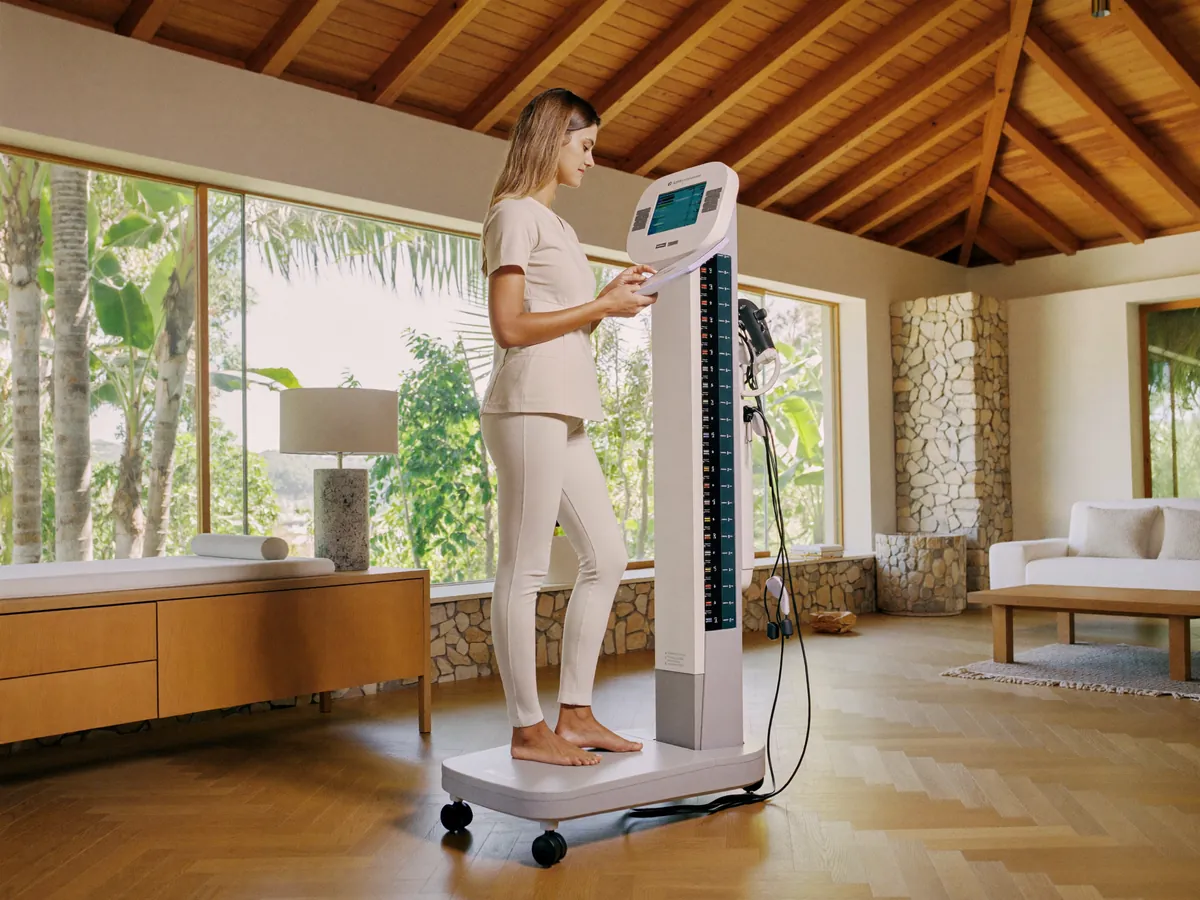
Every week our supply desk gets some version of the same question — from a longevity clinic founder, a gym chain director in Jakarta SCBD, a retreat operator planning an assessment room: should we buy an InBody, or go straight to DEXA? Having delivered 100+ equipment projects across Indonesia over the past three years, we can answer with unusual honesty, because we supply BIA and air displacement systems but do not sell DEXA at all. There are good physics reasons and very practical Indonesian licensing reasons behind that choice, and by the end of this comparison you will know exactly which side of the line your business sits on.
How DEXA measures body composition
Dual-energy X-ray absorptiometry sends two X-ray beams at different energy levels through the body. Bone mineral, lean tissue and fat attenuate the two energies in characteristically different proportions, so by comparing what arrives at the detector the software resolves each pixel of the scan into tissue types. That gives DEXA its famous three-compartment output — fat mass, lean soft tissue and bone mineral content — plus regional detail and a visceral fat estimate. The radiation dose per whole-body scan is genuinely tiny, on the order of 1–10 microsieverts, a fraction of a chest X-ray. A scan takes six to thirteen minutes on the table, and precision for repeat fat-mass measurements is in the one-to-two percent range on a well-calibrated machine.
How InBody measures body composition
The InBody 970 body composition analyzer is the flagship of the other approach: direct segmental multi-frequency bioelectrical impedance. Eight tactile electrodes push a tiny alternating current through the body at frequencies from 1 kHz to 3 MHz. Low frequencies travel around cells through extracellular water; high frequencies cross cell membranes and see intracellular water too. From the segmental impedance data the device computes total body water, lean mass and fat mass per limb and trunk, plus phase angle and the ECW/TBW fluid ratio — the two numbers longevity physicians increasingly build programs around. A test takes under a minute standing on the platform, no radiation, no operator qualification, no room shielding.
The accuracy question, answered without marketing
At group level, published comparisons put the correlation between research-grade multi-frequency BIA and DEXA for fat-free mass at roughly r = 0.94–0.98. For an individual on a given day, the two can disagree by two to five percentage points of body fat — BIA drifts with hydration, recent meals, alcohol and training, while DEXA itself leans on assumptions about lean-tissue hydration and can shift with scanner brand and software version. Neither is the true gold standard; that title belongs to the four-compartment model used in validation labs, which is exactly what the seca mBCA 555 medical BIA was validated against in peer-reviewed studies.
The practical rule we give buyers: DEXA is better at absolute numbers on one day; a disciplined BIA protocol is at least as good at tracking change over months — and change is what your members are paying to see.
Standardise the conditions — morning tests, fasted or three hours post-meal, no heavy training beforehand — and BIA repeatability tightens dramatically. That is a staff-training problem, not a hardware problem, and it costs nothing.
The part nobody tells you: licensing in Indonesia
Here is where the comparison stops being academic. A DEXA scanner is an X-ray device, and in Indonesia that means BAPETEN (the nuclear regulatory agency) utilisation permits, a lead-shielded room, a licensed radiation protection officer, a qualified radiographer on staff, annual compliance inspections and medical-facility licensing. Realistically, DEXA belongs inside hospitals and licensed imaging clinics. A BIA unit, by contrast, plugs into a standard 220 V socket the day it arrives from our Denpasar warehouse; the Kemenkes AKL registration is handled at import — we covered the whole process in our guide to importing wellness equipment into Indonesia. For a gym, spa, retreat or non-hospital longevity clinic, that difference is decisive on its own.
Cost per machine, cost per test
| Factor | DEXA (hospital-class) | InBody 970 | BOD POD GS-X |
|---|---|---|---|
| Equipment price | $55,000–110,000 / IDR 900 juta–1.8 miliar | ~$90,000 / ≈IDR 1.45 miliar | ~$75,000 / ≈IDR 1.2 miliar |
| Room and compliance | Shielded room fit-out IDR 150–300 juta, BAPETEN permits, radiographer salary | Any air-conditioned corner, no permits to operate | Approx. 2.5 m² room, no radiation compliance |
| Test time | 6–13 minutes plus positioning | Under 1 minute | About 10 minutes |
| Throughput | 3–4 tests/hour | 12–15 tests/hour | 4–5 tests/hour |
| Typical Indonesian retail price per test | IDR 1.5–3 juta | IDR 150,000–400,000 | IDR 500,000–1 juta |
| Staff requirement | Licensed radiographer | Any trained front-desk staff | Trained operator, half-day certification |
Notice the business models hiding in that table. DEXA is a low-volume, high-ticket hospital service. InBody is a high-frequency habit product — the same member tests every six to eight weeks for years. Over a year, one InBody 970 doing eight paid tests a day at IDR 250,000 generates more revenue than most standalone DEXA services, at a fifth of the compliance overhead.
Talk to a supply manager on WhatsApp — tell us your facility type and city and we will give you a straight recommendation with landed IDR pricing, usually the same day — the ~ figures here are indicative, and the final price is confirmed by a supply manager against the current exchange rate, freight method and delivery route.
Which to choose if…
- You are a hospital or licensed imaging centre building an executive check-up floor in Jakarta or Surabaya: DEXA makes sense — you already have the radiology infrastructure, and bone density reporting adds billable value. Design the package around it with our health screening package guide.
- You run a longevity clinic, biohacking studio or premium gym outside a hospital: the InBody 970 (or the medically validated seca mBCA 555 if physicians lead your programs) delivers the tracking data, throughput and member experience you actually need — no BAPETEN file required.
- You are a sports science lab or athlete academy: the BOD POD GS-X gives you a radiation-free reference method examiners respect, with hydration-independent physics.
- Budget is the constraint: the ACCUNIQ BC730 body composition analyzer starts around $22,500 and keeps 80 percent of the client experience at a fraction of the flagship price.
- You want DEXA-style prestige without X-ray: pair BIA with a 3D body scanner — visual avatars plus segmental muscle data photograph better on Instagram than any DEXA printout.
Making BIA results defensible: the five-minute protocol
Whichever side you land on, the cheapest accuracy upgrade is procedural. We hand every client the same one-page protocol at installation: test in the morning where possible; no meals for three hours and no alcohol for twelve; empty bladder before stepping on; no hard training earlier that day; wipe the electrodes and stand still through the reading. Clinics that enforce this see test-retest noise shrink to the point where a 0.4 kg muscle change over six weeks reads as signal, not scatter. Log the conditions on each report — hydration caveats included — and your BIA archive will stand up to any sceptical member who walks in clutching a hospital DEXA printout. The two datasets will rarely match absolutely, and that is fine: what matters clinically and commercially is that each instrument agrees with itself, visit after visit, so the trend line stays trustworthy.
Our verdict after 100+ equipment projects
Buy the instrument that matches your licensing reality and your re-test cadence, not the one with the most impressive name. For nine out of ten wellness businesses in Indonesia that means multi-frequency BIA: same-day operation, 12+ tests an hour, IDR pricing your members will pay monthly, and accuracy that — under a disciplined protocol — tracks progress as reliably as the X-ray alternative. The full range is in our body composition catalog, with stock in Denpasar and Jakarta, installation and staff training included.
Still torn? Start with our full body composition analyzer buyer's guide, or message us on WhatsApp for a comparison built around your floor plan, your city and your budget in IDR.
The WellnessEquip Indonesia supply desk sources, imports and installs wellness equipment across Indonesia. Questions about your project? Message a supply manager on WhatsApp — honest answers, no hard sell.
— FAQ
Frequently asked questions
Is InBody as accurate as a DEXA scan?
At group level the two correlate strongly (around r = 0.94–0.98 for fat-free mass in published studies). On a single day an individual result can differ by two to five body-fat percentage points, mainly from hydration. Under a standardized protocol, InBody tracks change over time as reliably as DEXA for wellness purposes.
Does a DEXA machine need a special license in Indonesia?
Yes. DEXA is an X-ray device, so it requires BAPETEN radiation utilisation permits, a shielded room, a licensed radiation protection officer and operation inside a licensed medical facility. BIA analyzers like the InBody 970 carry no radiation requirements and can operate in gyms, spas and clinics immediately.
How much does a DEXA scanner cost compared to an InBody 970?
A hospital-class DEXA runs $55,000–110,000 (IDR 900 juta–1.8 miliar) before shielding and staffing. The InBody 970 lands in Indonesia at around $90,000 (≈IDR 1.45 miliar) installed, and cheaper professional BIA options start around $22,500.
Can a wellness clinic offer both InBody and DEXA testing?
Only if it is a licensed medical facility with radiology capability. In practice, most Indonesian longevity clinics run BIA in-house for frequent tracking and refer clients to a partner hospital for an annual DEXA when bone density data is clinically needed. It is a clean division that avoids the compliance burden.
Which should a gym or clinic buy: InBody or DEXA?
For gyms, spas and non-hospital clinics, a multi-frequency BIA analyzer such as the InBody 970: no BAPETEN permits, tests in under a minute and 12–15 tests an hour. DEXA makes sense only inside a licensed hospital or imaging centre that already runs radiology.
When is a BOD POD the better purchase?
When you need a radiation-free reference method for sports science or research. The BOD POD GS-X uses air displacement, takes a few minutes per test and needs a small climate-controlled room, but no radiation compliance.
— Keep reading
Related guides
Buyer Guides · 6 min read
How to Choose a Body Composition Analyzer for Your Gym or Clinic
From a $22,500 BIA unit to the $75,000 BOD POD: how the technology actually works, what four professional analyzers cost in Indonesia, and which one fits your gym, clinic or longevity studio.
Business · 6 min read
How to Open a Longevity Clinic in Bali: Licenses, Budget, Equipment
Legal structure, clinic licensing, AKL device registration, three equipment budget tiers and honest payback math — everything we tell founders who want to open a longevity clinic in Bali.
Business · 6 min read
Designing Health Screening Packages That Sell: A Clinic Playbook
Indonesians spend an estimated $1.5–2 billion a year on medical care abroad, much of it on check-ups. A station-by-station guide to building screening packages that keep that revenue in your clinic.